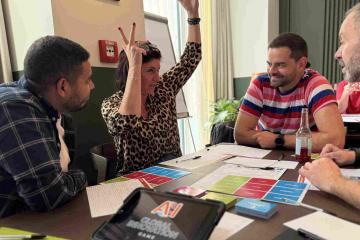
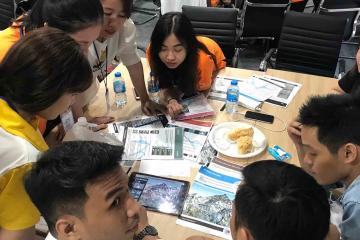
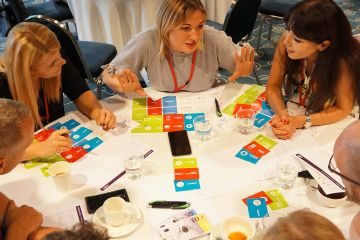
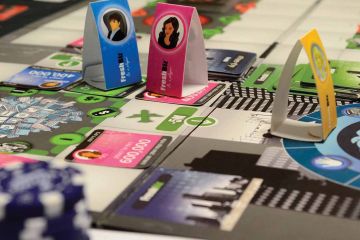
Accelerate team learning, creative thinking and improve knowledge retention with a fun experiential game.
Experiential learning programs and business games are real life simulations that are interactive, fun and creative. By using a metaphor from reality, experiential team building creates a ‘safe’ distance from the working environment. They are interactive, providing practical tasks which require participants to draw on their past experiences and also apply creative thinking, strengthening the neural connections in the brain for lasting outcomes. Business games are designed to focus on a specific set of learning outcomes through a process of practice, problem-solving and decision making. These steps accelerate learning and improve knowledge retention.
Participants are encouraged to work together as a team where each individual’s role is vital. This fosters teamwork and also increases individual engagement and motivation. This further ensures that the learning outcomes are genuine and shared as a team. In this relaxed learning environment, individuals and teams are able to experiment and take risks. Mistakes are inevitable but a valuable part of the learning process.
A debrief which encourages review and reflection is key to the experiential learning process. Research shows that by incorporating hands-on experiences with abstract concepts, and then reflecting on the outcome, participants engage more regions of their brain and make true, personal connections with the learning. They reflect on the outcomes for their team and how their individual actions affected it and compare their actions with those of others. This analysis helps them better understand how the concepts learned can be applied to other, varied circumstances.
Look at this selection of related popular programs. Need help in deciding? Looking for something else?